Selected
Works.
Professional expertise and selected projects across automotive, embedded validation, runtime analysis, engineering automation, and cloud CI/CD.
Selected
Works.
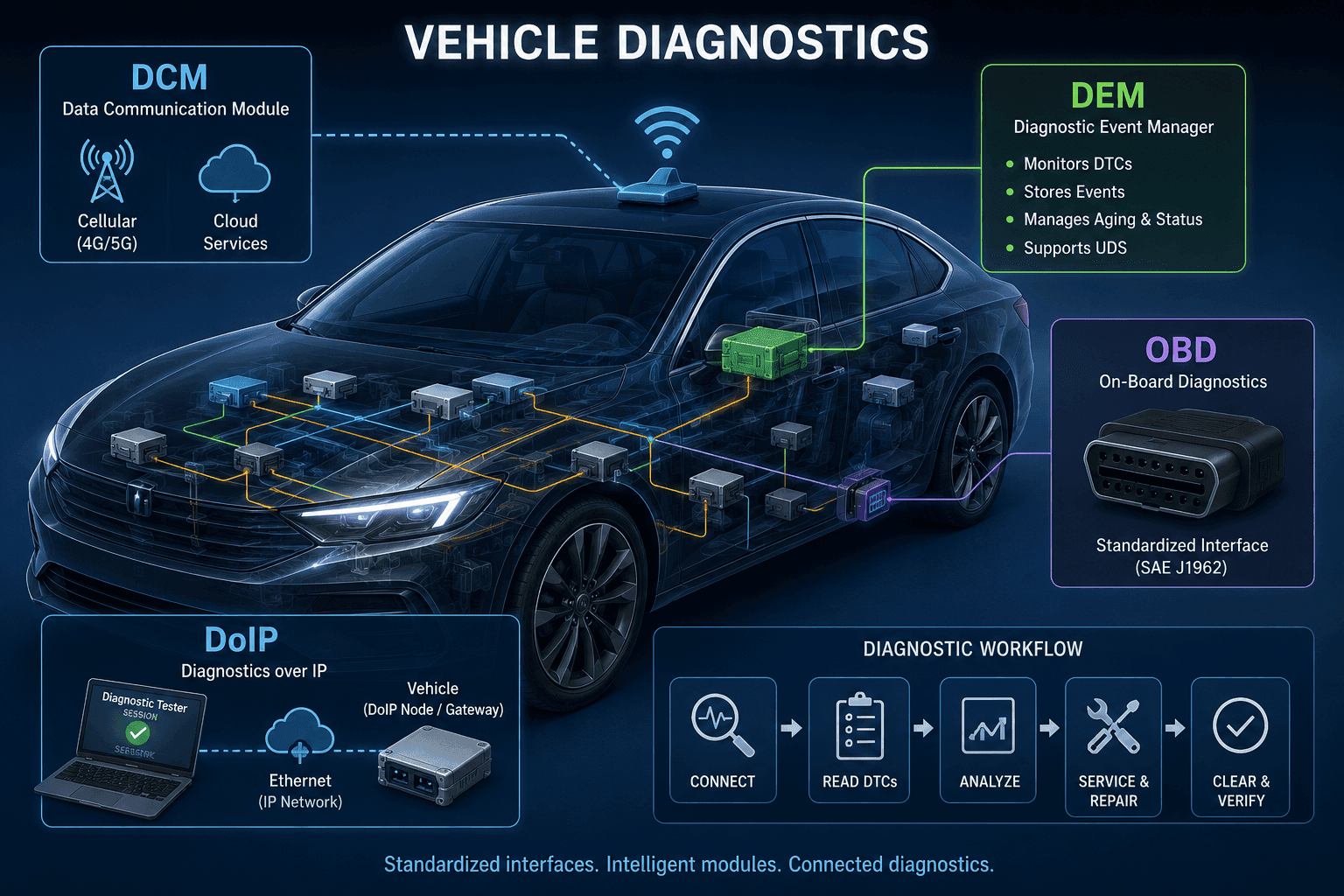
Embedded Systems Integration & Automotive Diagnostics Specialist
Integrating and validating complex embedded systems across configuration, generated code, middleware, runtime architecture, diagnostics, application software, and engineering automation.
Technical capability map
Integration, diagnostics, validation, communication, runtime analysis, and customer-facing engineering across the embedded software stack.
- Automotive Embedded Diagnostics
- End-to-end understanding of diagnostic functionality from configuration and diagnostic descriptions through AUTOSAR middleware, application interfaces, runtime execution, and persistent diagnostic data.
- AUTOSAR Classic Integration
- Practical experience with AUTOSAR Classic architecture and integration, particularly diagnostic-related modules and interfaces including DCM, DEM, PduR, CanTp, DoIP, SoAd, BswM, and FiM.
- UDS / Diagnostic Services
- Understanding and troubleshooting of UDS/OBD diagnostic request-response behaviour, diagnostic identifiers, DTC handling, events, callbacks, and application integration.
- Diagnostic Data Modelling
- Working knowledge of DIDs, DTCs, diagnostic events, debounce mechanisms, ports, callbacks, CDD/DEXT descriptions, and their connection to application data.
- Configuration-Driven Embedded Software
- Strong understanding of how ARXML, ECU configuration, CDD/DEXT models, and configuration parameters produce generated interfaces and influence runtime software behaviour.
- Cross-Layer Root-Cause Analysis
- Tracing faults across configuration, generated C code, RTE interfaces, BSW modules, OS/runtime behaviour, and application software rather than treating the visible symptom as the root cause.
- Embedded Software Integration
- Resolving interface mismatches between generated software and application APIs and analysing interactions between application components and AUTOSAR infrastructure.
- Generated-Code Analysis
- Reading and analysing generated embedded C code to understand how configuration decisions translate into software behaviour and detecting unexpected or inconsistent generated output.
- Multicore & Partitioned ECU Architecture
- Understanding execution context, event ownership, core assignment, OS partitions, and restrictions associated with cross-core execution.
- ECU Integration & Validation
- Integration, configuration, testing, and debugging of embedded ECU software across application and platform layers.
- Technical Issue Reproduction
- Reproducing customer-specific failures using project configurations, software versions, logs, environment differences, and controlled test setups.
- Technical Escalation Engineering
- Translating broad customer issues into precise engineering questions, gathering reproduction evidence, and working with specialist development and domain teams.
- Legacy Migration & Platform Modernisation
- Migrating diagnostic descriptions, configuration models, scripts, and development workflows while preserving expected system behaviour.
- Customer-Facing Embedded Engineering
- Explaining complex software behaviour, limitations, workarounds, dependencies, and corrective actions to customers and project stakeholders.
- Automotive Communication
- CAN, CAN-FD, LIN, Automotive Ethernet, DoIP, and SOME/IP-related integration and analysis.
- Vector Tool Ecosystem
- CANoe/CANalyzer and DaVinci-related configuration, integration, and diagnostic debugging workflows.
- Debugging & Failure Analysis
- Systematic debugging, log analysis, interface tracing, runtime investigation, and root-cause isolation.
- Embedded Systems Engineering
- Embedded C/C++ development, integration, and debugging across ARM, TriCore, and STM32-oriented systems, with experience spanning Linux, RTOS, and hardware-software interfaces.
- System Integration & Engineering
- Interface and dependency analysis, software execution-flow investigation, requirements-to-implementation analysis, cross-component debugging, integration testing, and technical problem decomposition.
- System Validation
- Runtime behaviour analysis, software and hardware integration, SIL/HIL concepts, requirements-based testing, failure reproduction, and system-level validation.
- Embedded Software Analysis & Runtime Verification
- Developing expertise in ELF analysis, symbol and function extraction, dependency and call graphs, runtime tracing, function-level simulation, and hardware-independent embedded validation.
- Standards-Based Software Verification
- Developing approaches for validating diagnostic and runtime behaviour against AUTOSAR architecture, UDS services, interfaces, requirements, and automotive diagnostic specifications.
- Python Engineering Automation
- Python-based automation, test tooling, API integration, data processing, SQLite-backed applications, CLI development, and rapid engineering prototypes.
- AI-Assisted Engineering & Platform Tooling
- Local LLM applications, Ollama, AI agents, MCP architecture, tool-using models, context and retrieval systems, alongside Git, Jenkins, CI/CD, Docker, QEMU, and Yocto concepts.
Smart Home Automation Simulation (Udacity C++ Capstone)
Built a multi-threaded simulation of a smart home system: weather-driven state changes, automatic lighting behavior, and temperature/heater control logic. Implemented OOP modules and thread-based simulation loops, plus an OpenCV-based visualization.
Azure CI/CD for Flask ML Service (Udacity Azure Project)
Implemented a CI/CD pipeline for a Flask ML web app using GitHub Actions for CI and Azure for deployment, including automation scripts and a load test setup. Demonstrates an end-to-end 'commit → test → deploy' workflow.
Scalable IaaS Web Server on Azure (Terraform + Packer)
Infrastructure Operations project deploying a scalable web server on Azure using Packer (image build) + Terraform (infra provisioning), plus policy setup to enforce governance (tags).
Radar Post-Processing Optimization on ARM Cortex-A53 (Master's Thesis)
Optimized radar post-processing algorithms on an ARM CPU by combining manual algorithm changes and compiler-driven optimization. Reimplemented the CFAR stage using ARM NEON vectorization, reduced redundant loops across range gates, and evaluated GCC vs Clang performance. Results showed the system could scale to a 6-antenna implementation with healthy headroom in the defined scenario, and highlighted the performance impact of dynamic memory allocation.
LED Electronic Notice Board (Bachelor's Thesis)
Designed and built a LED-based electronic notice board controllable from an Android phone—hardware integration + embedded firmware + communication path from mobile to device.
C++ Nanodegree Portfolio (Memory, Concurrency, Route Planning)
A portfolio covering route planning, system monitoring (OOP), memory management concepts, and concurrency simulations.